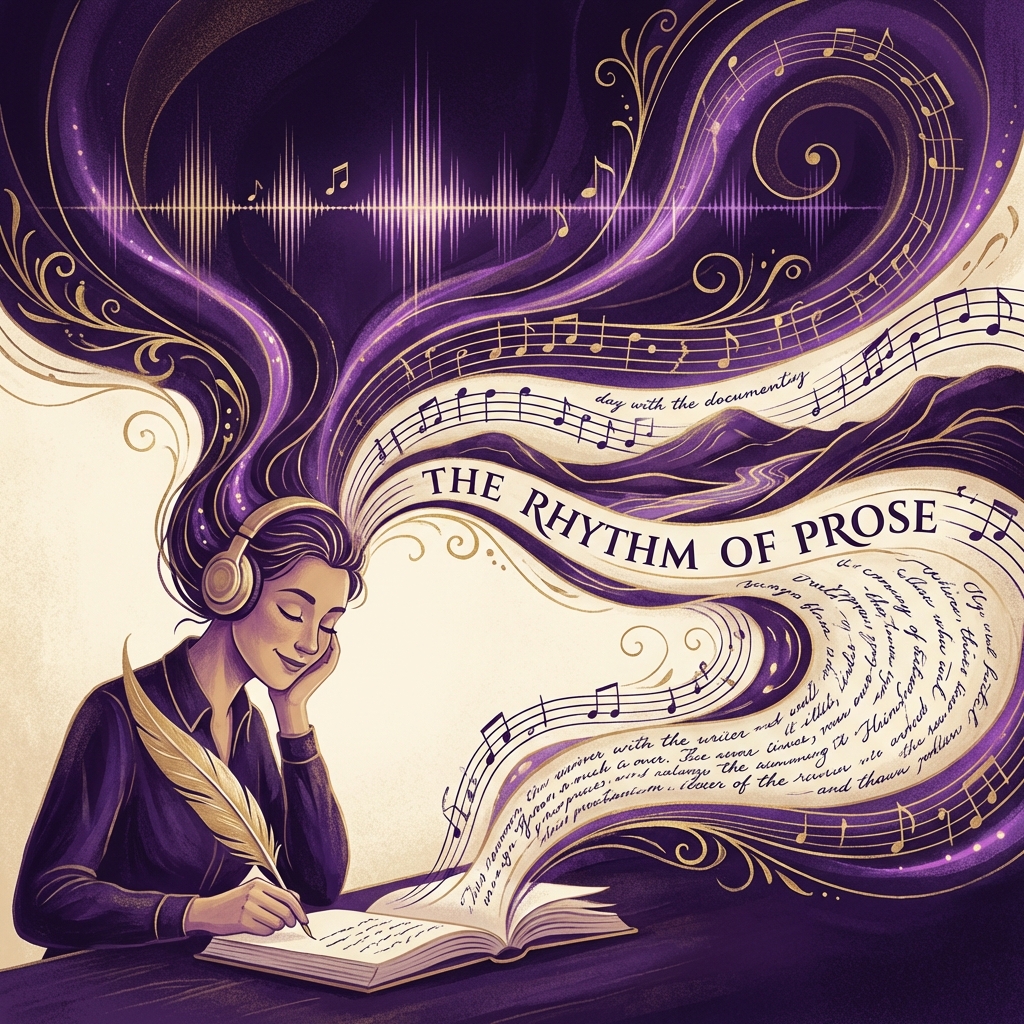
There is a famous passage crafted by the writer Gary Provost that perfectly illustrates the concept of prose rhythm. It goes like this:
This sentence has five words. Here are five more words. Five-word sentences are fine. But several together become monotonous. Listen to what is happening. The writing is getting boring. The sound of it drones. It’s like a stuck record. The ear demands some variety.
Now listen. I vary the sentence length, and I create music. Music. The writing sings. It has a pleasant rhythm, a lilt, a harmony. I use short sentences. And I use sentences of medium length.
And sometimes, when I am certain the reader is rested, I will engage him with a sentence of considerable length, a sentence that burns with energy and builds with all the impetus of a crescendo, the roll of the drums, the crash of the cymbals–sounds that say listen to this, it is important.
This single passage teaches you more about the mechanics of sentence structure than most full-length textbooks on grammar.
The Silent Soundtrack of Reading
Writing is visually consumed via the page or the screen, but it is fundamentally processed by the auditory centers of the human brain. When we read, even silently, we "sub-vocalize." We hear the words, the cadences, and the pauses in our head. We are essentially narrating an internal audiobook to ourselves.
If you write exclusively for the eye—focusing only on grammar, spelling, and conveying raw information—your prose will invariably feel stiff, wooden, and distinctly un-human. To create compelling, immersive fiction, you must write for the ear.
The Function of Short Sentences: Short sentences drastically increase the narrative pace. They create a profound sense of tension, urgency, and immediate danger. They mimic a rapid, panicked heartbeat. When used correctly, they hit the reader like physical blows. Examples: He stopped breathing. The locked door slowly opened. He saw the gun.
The Function of Long Sentences: Long sentences deliberately slow the narrative pace. They provide the necessary runway for deep complexity, intricate description, and meandering philosophical thought. They mimic a long, deep sigh, or a slow-moving river reflecting the afternoon sun. They allow the reader's pulse to settle, inviting them to dwell in the beauty of the moment or the depths of a character's interiority.
The Crucial 'Read-Aloud' Test
There is only one foolproof method to test the rhythm of your prose: you must read your work aloud. And I mean literally, physically out loud, engaging your vocal cords and the acoustics of your room.
When you read silently, your brain's auto-correct feature seamlessly skips over clumsy phrasing, missing words, and repetitive structures because it already knows what you meant to say. But your tongue is not so forgiving.
If you physically stumble over a phrase while reading it aloud, that is a glaring neon sign that the rhythm is broken and the sentence must be rewritten. If you run completely out of breath in the dead middle of a sprawling sentence, it desperately needs to be broken up with punctuation or cut in half. If you find yourself gravitating toward a repetitive, sing-songy, nursery-rhyme pattern across a paragraph, you must actively disrupt it.
You are the composer, and you are the conductor. The punctuation marks—the commas, the em-dashes, the periods—are your baton. Control the breath of the reader, manipulate the tempo of the scene, and you will fundamentally control their emotional experience.