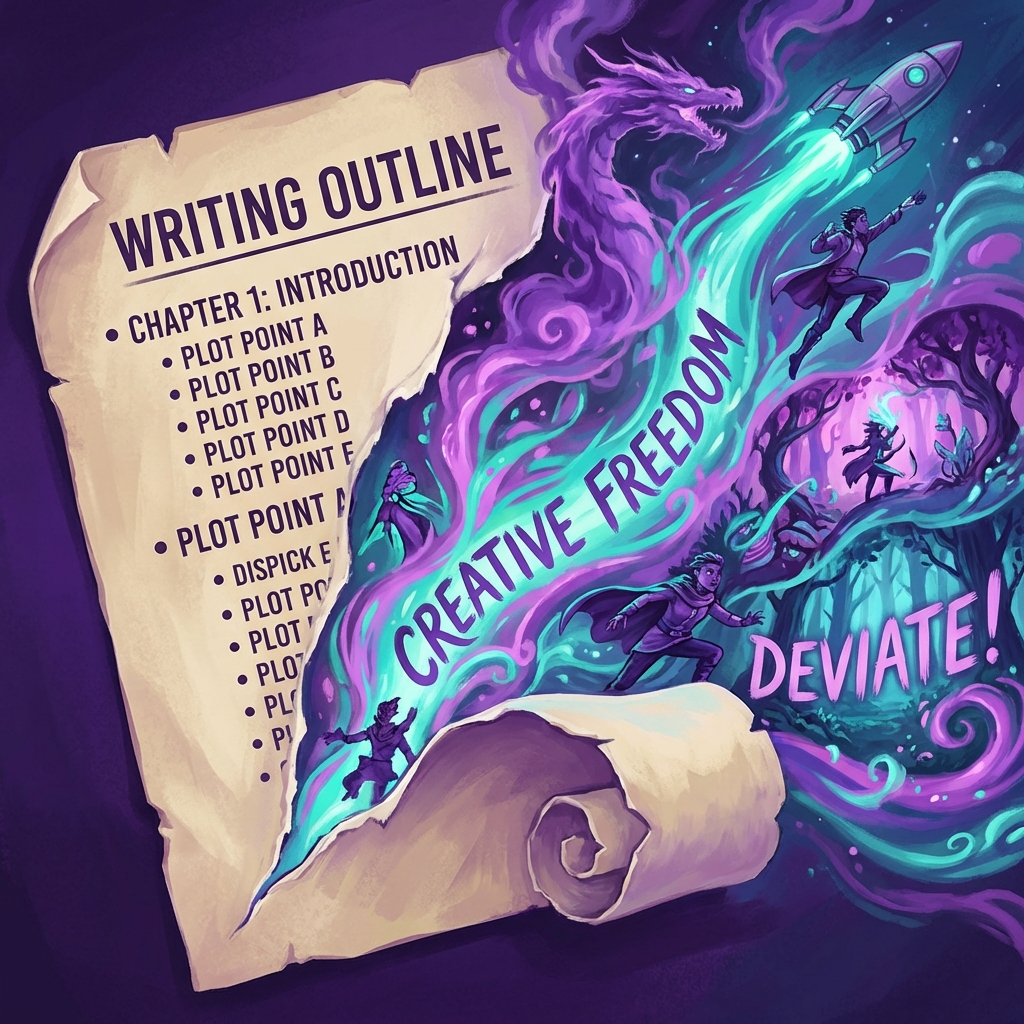
You did everything right. You are a responsible, diligent writer. You spent the entire month of October meticulously planning your novel. You used the Story Forge to build your character arcs. You mapped out the three-act structure. You have a comprehensive, color-coded, 20-page outline sitting on your desk. You know exactly what happens in Chapter 1, you know the midpoint twist in Chapter 10, and you know exactly how the climax resolves in Chapter 20.
But then, reality hits. You are actually in the trenches writing Chapter 6, deep in the flow state, and suddenly your protagonist does something totally, spectacularly unexpected. The outline says she opens the door and accepts the mission. But as you type the dialogue, she firmly refuses to open the door. Instead, she verbally eviscerates her supposed ally. In the next scene, instead of fighting the antagonist, she kisses him.
Immediate panic sets in. The structural alarms in your brain start blaring. "This isn't in the outline! If she rejects the mission here, then the journey to the capital in Chapter 7 doesn't happen! The midpoint twist is ruined! The entire structural integrity of the novel is collapsing!"
You face a critical crossroads. Do you hit backspace, delete the spontaneous scene, force the character back onto the predetermined rails, and make her behave according to the plan?
Absolutely not. You follow her.
The Sign of a Living Story
When a character "misbehaves" and deviates from your meticulously crafted outline, it is almost never a mistake. On the contrary, it is usually the greatest sign of success. It means the character has finally come alive. It means that your creative subconscious has synthesized the character's psychology so deeply that your conscious, logical brain—the part that wrote the outline—has been overruled by emotional truth.
If you choose to force the character back onto the outline against the natural flow of the scene, the reader will feel it. The character will suddenly feel stiff, unnatural, and robotic. They will feel exactly like what they are in that moment: a wooden puppet being forcibly manipulated by an author to serve the mechanical needs of a plot, rather than a living being making authentic choices.
But if you have the courage to let them deviate, to let them make the messy, unexpected choice, the story instantaneously becomes organic. It becomes real. It breathes.
The Map vs. The Territory
An outline is nothing more and nothing less than a map. A map is undeniably useful for planning a trip before you leave your house. It gives you a general sense of direction and ensures you don't start walking completely the wrong way.
But imagine you are actually out on the hike, navigating the wilderness. The map in your hand says the path goes straight ahead. But when you look up, you see a newly formed, massive sinkhole right where the path should be. You do not keep walking forward and fall into the hole simply because "the map says the road is here." You adjust. You walk around it. You find a new path.
The drafting process is the territory. It is the reality on the ground. The outline is just a map, and a map is merely an educated guess you made before you actually started walking.
When the reality of the draft conflicts with the guess of the outline, reality must always win. If the story organically wants to go left, you must turn the wheel and go left.
The Cost of Authenticity
Following the character off the outline is not the easy path. Let's be unequivocally clear: it means you have just created a massive amount of work for yourself. It means you will likely have to throw away the entire second half of your beautiful, 20-page outline. It means you have to reconceive the midpoint, redesign the climax, and figure out on the fly how to weave these new unscripted choices into a satisfying conclusion.
It is harder, it is scarier, and it requires significantly more creative heavy lifting. But the resulting story will be deeper, richer, and infinitely more authentic. Readers do not fall in love with outlines; they fall in love with characters. Let your characters lead.