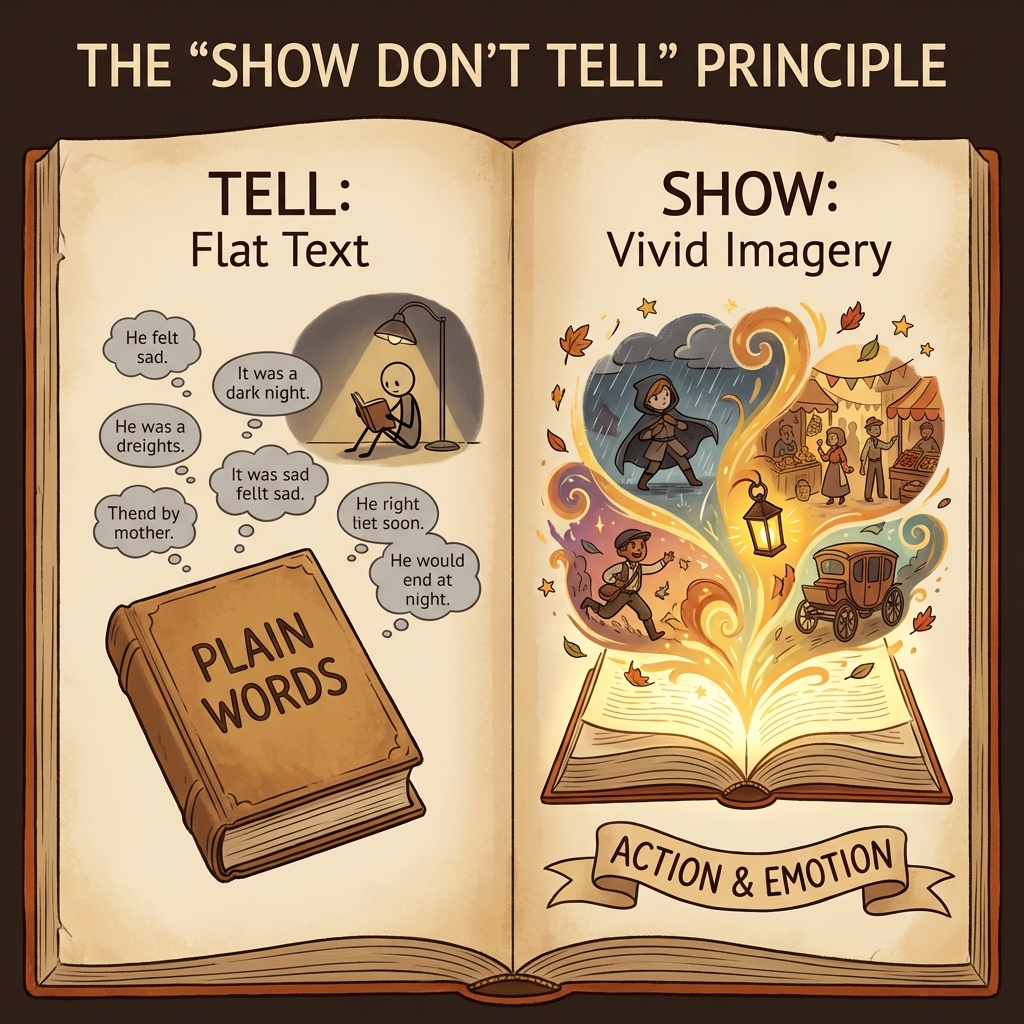
"Show, Don't Tell" is undisputedly the most repeated, most universally taught piece of advice in the entirely of creative writing philosophy. It is literally the first thing you learn in any high school creative writing class, any MFA program, and any writing guidebook you pick up off the shelf.
The concept is simple.
Tell: He was incredibly angry.
Show: His face flushed crimson. He clenched his fist so tightly his knuckles turned white. He kicked the nearest chair across the room.
The core theory behind this axiom is that "showing" creates a deeply immersive, cinematic experience for the reader. It respects the reader's intelligence by allowing them to actively deduce the emotional state of the character from their physical actions and the surrounding environment, rather than being passively spoon-fed the information by an omniscient narrator. And for the most part, this theory is absolutely correct and foundational to good writing.
But like all rigid rules in art, if you follow it blindly and apply it 100% of the time, you will inevitably write a terrible, unreadable book.
The Fatal Flaw of Showing Everything
If you take "Show, Don't Tell" as gospel and attempt to "show" every single action, transition, and minor emotion in your narrative, your book will be 5,000 pages long and impossibly, excruciatingly boring.
Imagine trying to strictly "show" a character driving to work through morning traffic. He inserted the silver key into the ignition. He turned it clockwise. The V6 engine caught with a low growl. He depressed the brake pedal, shifted the gear stick into reverse, and slowly looked into the smudged rearview mirror...
The reader's immediate reaction is: Who cares? Unless that specific car is rigged to explode when it hits 50 miles per hour, or unless the act of driving is a metaphor for his spiraling mental state, all of those hyper-specific details are utterly useless. They drag the pacing to an absolute halt. Just tell us: He drove to work.
The Art of the Balance: Scene vs. Summary
The true, nuanced art of novel writing is not about showing everything; it is about masterfully balancing Scene (Showing) and Summary (Telling).
Think of your novel as a film. "Showing" is when the camera is rolling, the actors are speaking their lines in real-time, and we are watching the drama unfold second by second. "Telling" is the classic cinematic montage or the fading text on the screen that reads, "Three Weeks Later."
You MUST Use Showing for:
- High emotional stakes and deeply intense confrontations.
- The climactic moments of your plot where everything is on the line.
- The very first introductions of your main characters or antagonists.
- The "good stuff"—the scenes your reader bought the book to experience.
You MUST Use Telling for:
- Transitions in time spanning days, weeks, or years. ("Three miserable weeks passed.")
- Mundane, daily routines and travel that do not develop character or advance the plot.
- Crucial background information or world-building exposition that needs to be delivered quickly and cleanly so we can get right back to the central conflict.
Embrace the Power of the Tell
Do not be afraid to tell. Sometimes, a stark, beautifully constructed "telling" sentence lands infinitely harder and carries far more emotional weight than three pages of a character staring pensively out a rain-slicked window while listening to sad music.
Consider the devastating power of a sentence like: He never properly recovered from the loss. That is pure telling. But it delivers a massive emotional payload with incredible efficiency. Use the power of "Telling" to ruthlessly speed up the boring, connective tissues of your story, precisely so you can spend your valuable word count and the reader's attention span fully "Showing" the parts that actually matter.